Work & technique
Work & technique
1886 — 1955
Etching, watercolour, pencil and oil paint: an oeuvre between artwork, city document and mass-distributed image.
etching · drypoint · colour etching · aquatint · lithography · oil paint

Not solely a ‘forgotten master’, but not solely a topographical draughtsman either: it is precisely the tension between artwork, city document, editioned print and mass-distributed image that makes Eugène Rensburg’s oeuvre remarkable.
Techniques and supports
Filter the oeuvre register by technique to see documented examples per technique.
- Drawings
- Pen and ink, pencil, chalk, washed drawing and combinations with watercolour.
- Printmaking
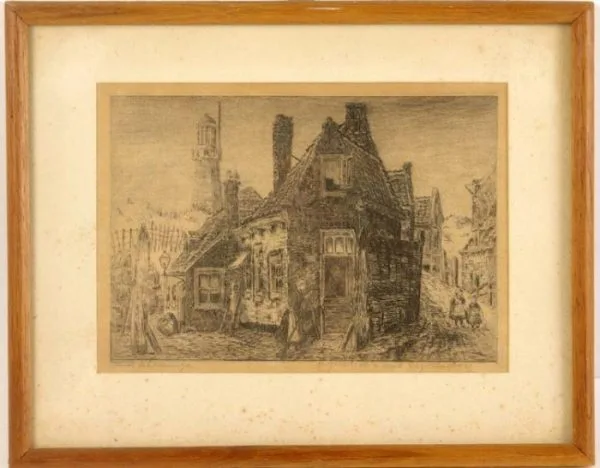
- Etching, drypoint, colour etching, aquatint, double-tint etching, vernis mou and à la poupée impressions; also lithography and offset after designs drawn directly on the stone.
- Painting
- Oil on canvas or panel — far scarcer in public collections and market sources than the works on paper.
- Applied graphics
- Picture postcards, calendars, posters, jubilee series, Christmas and New Year cards, occasional prints, advertising and commemorative printing.
- Reproductions
- A single composition may survive as an original drawing, a printing plate, a series of impressions, a picture postcard, a calendar page, a later photograph or a digital reproduction.
Subjects

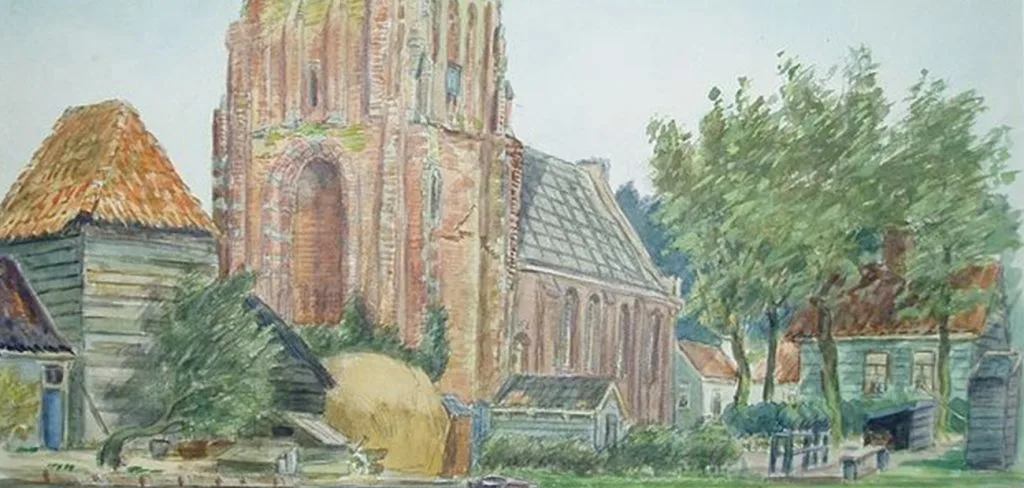
- Town and village views
- Rotterdam, The Hague, Amsterdam, Utrecht, Delft, Arnhem, Zutphen, Harderwijk, Zeeland — the core of the topographical oeuvre.
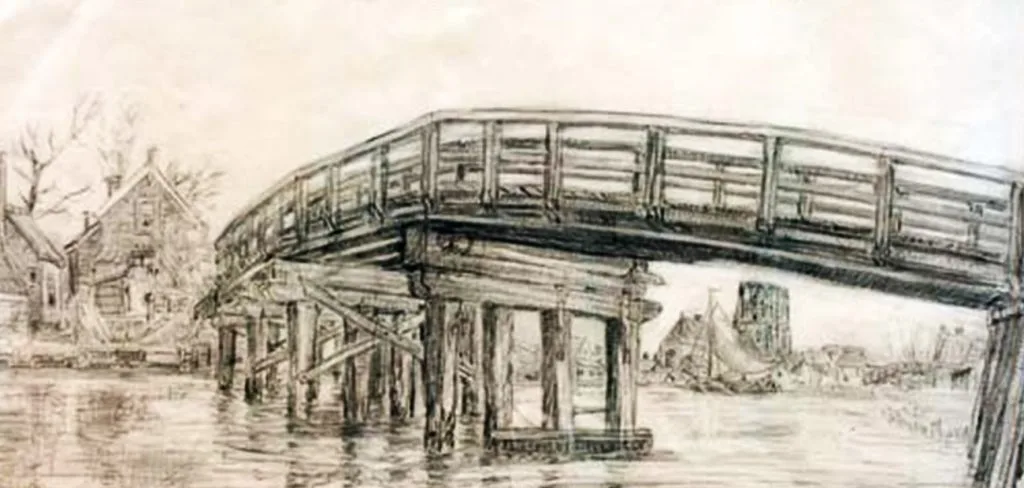
- Water, harbours and rivers
- Meuse, Thames, Rhine, Danube, Seine, Zuiderzee, canals and quays — connecting city, trade and landscape.
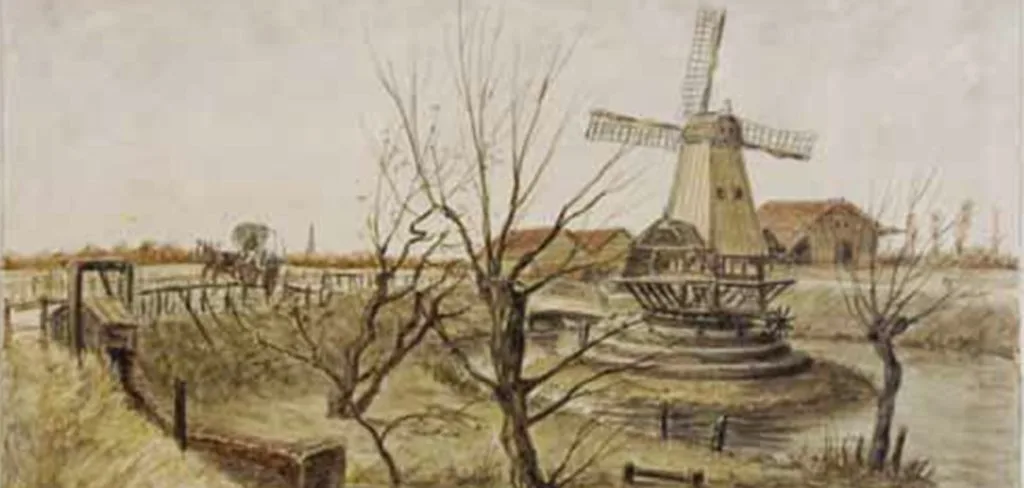
- Windmills and industry
- Delfshaven, Kralingse Plas, De Vlaggeman, the ’t Horstje paper mill — a vanishing landscape of production and culture.
- Monuments and historic architecture
- Churches, gates, castles and prisons — documentary and historical interest.
- Ceremony and current events
- The inauguration of Wilhelmina, Prinsjesdag, the Golden Coach, the funerals of Emma and Hendrik — visual reporting.
- Animals and aquaria
- Dog breeds, Artis, the Rotterdam Zoo, Monaco — a broadening from the 1920s and 1930s onwards.
- Applied graphics
- Mooi Holland calendars, postcards, Christmas seals — wide distribution beyond the museum circuit.

The Oedipus cycle (1913)
The Oedipus cycle (1913)
When Willem Royaards staged his open-air performance of King Oedipus in 1913, Rensburg made and distributed Oedipus prints in response to the production. In November that year the Leeuwarder Kunstkring showed an Oedipus etching alongside his city views.
The large black etching appeared in an edition of five; a smaller version is also known, printed as an épreuve d’artiste. It is Rensburg’s most ambitious figure work of these years — far removed from the quays and windmills that made his name.

Critical reception
Critical reception
Between 1911 and 1916 his technical command and urban construction were acknowledged, while watercolours and figures were sometimes found uneven, stiff or dry. Etchings and pen drawings generally received the best judgements.
In the 1920s attention shifted to travel prints and animals. From the 1930s Rensburg was increasingly seen as a topographical documentalist; after 1940 his value as the visual memory of vanished Rotterdam dominated.
